What you’ll take away
- A retained carrot top can produce leaves and fine roots without rebuilding the original storage taproot.
- The growing region and type of root matter; “something grew” is not enough to identify the result.
- Photosynthesis, root uptake and storage are connected roles, not interchangeable structures.
- A typical biennial pattern depends on conditions and is not an exact calendar promise.
- The activity uses drawings only, with an adult: no cutting, seeds, tasting, plant collection or online submission.
Green growth is not always a replacement vegetable
Imagine seeing a picture of a carrot top with fresh green leaves. A caption says, 'The carrot grew back!' What exactly grew back? The leaves may have grown, but that is different from growing another thick carrot root. Oregon State University explains that a retained carrot top can produce new leaves and fine roots, yet it does not replace the original storage taproot in this usual top-regrowth situation [1]. The interesting question is which growing parts remain, not simply whether anything looks greener.
We will investigate with drawings and made-up observation cards. Read with an adult who can help you follow the labels. No real carrots, seeds, cutting tools, jars, soil or tasting are needed. This is a paper activity, not a regrowing experiment. Keeping it on paper lets us slow down and ask a careful question: does the evidence show new leaves, new fine roots, or a new thick storage root? Those are three different things, even though people may use the same word, growth, for all of them.
A carrot top can resume vegetative growth without reconstructing the original swollen storage taproot. Oregon State University's explanation distinguishes a retained leaf-growing region and possible adventitious fibrous roots from the removed taproot and its growing point [1]. The distinction resolves a common ambiguity in regrowth claims: the presence of new plant tissue does not establish replacement of the particular organ harvested as the vegetable. The statement here concerns the ordinary carrot-top situation described by that source, not every form of plant regeneration.
This is an adult-supported diagram and reasoning activity. Easy and Technical follow the same question; the latter adds the terms meristem, adventitious root and biennial development for readers who want them. No practical cutting, propagation, germination, food preparation or plant-identification procedure is included. All observation cards are invented, not results of an experiment. The goal is to identify the organ and the evidence behind a claim, while keeping the child's activity entirely on paper. A photograph of greenery is not automatically a measurement of a rebuilt storage root.
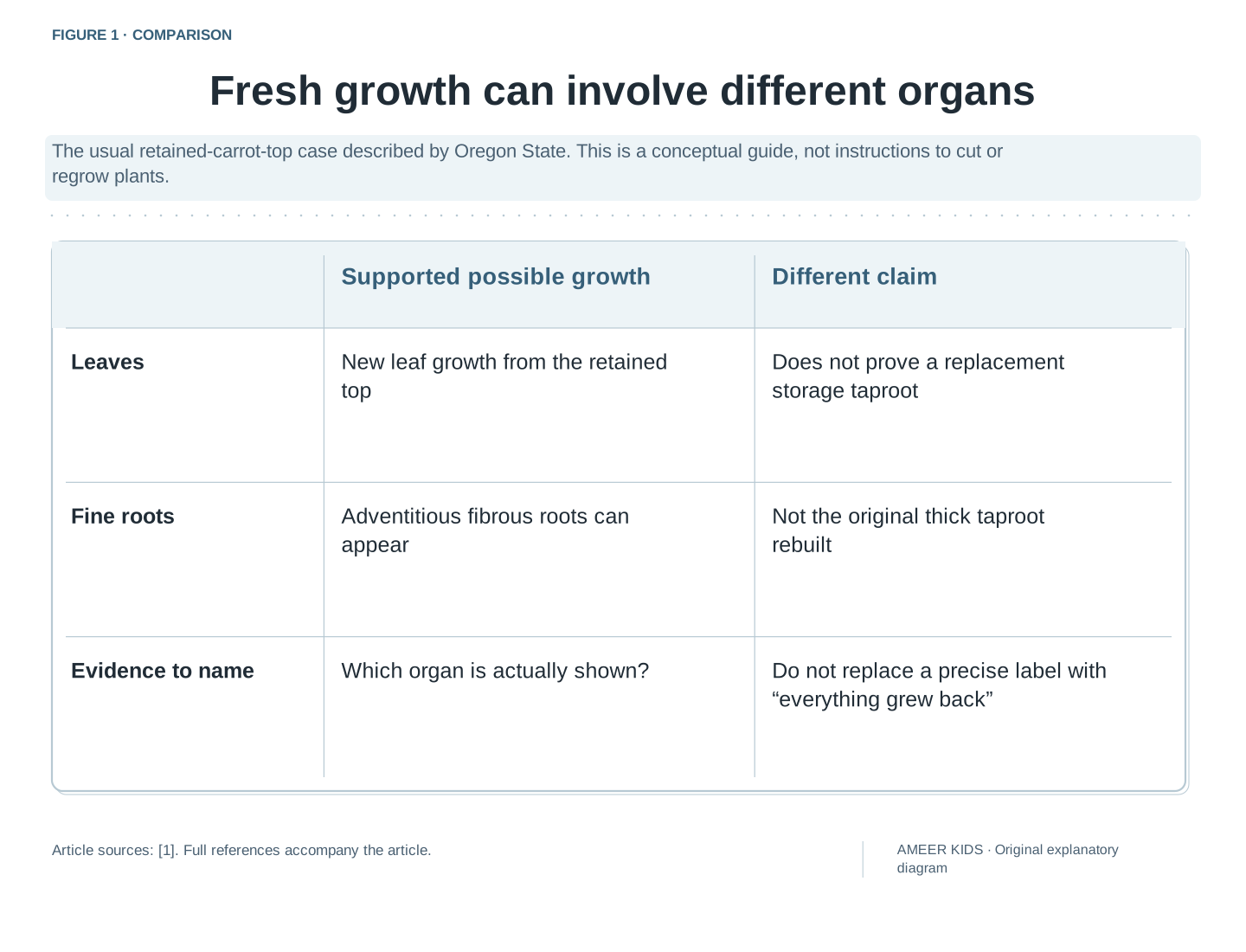
Read this figure in text
The usual retained-carrot-top case described by Oregon State. This is a conceptual guide, not instructions to cut or regrow plants.
| Item | Supported possible growth | Different claim |
|---|---|---|
| Leaves[1] | New leaf growth from the retained top | Does not prove a replacement storage taproot |
| Fine roots[1] | Adventitious fibrous roots can appear | Not the original thick taproot rebuilt |
| Evidence to name[1] | Which organ is actually shown? | Do not replace a precise label with “everything grew back” |
Figure references [1]
Read this figure in text
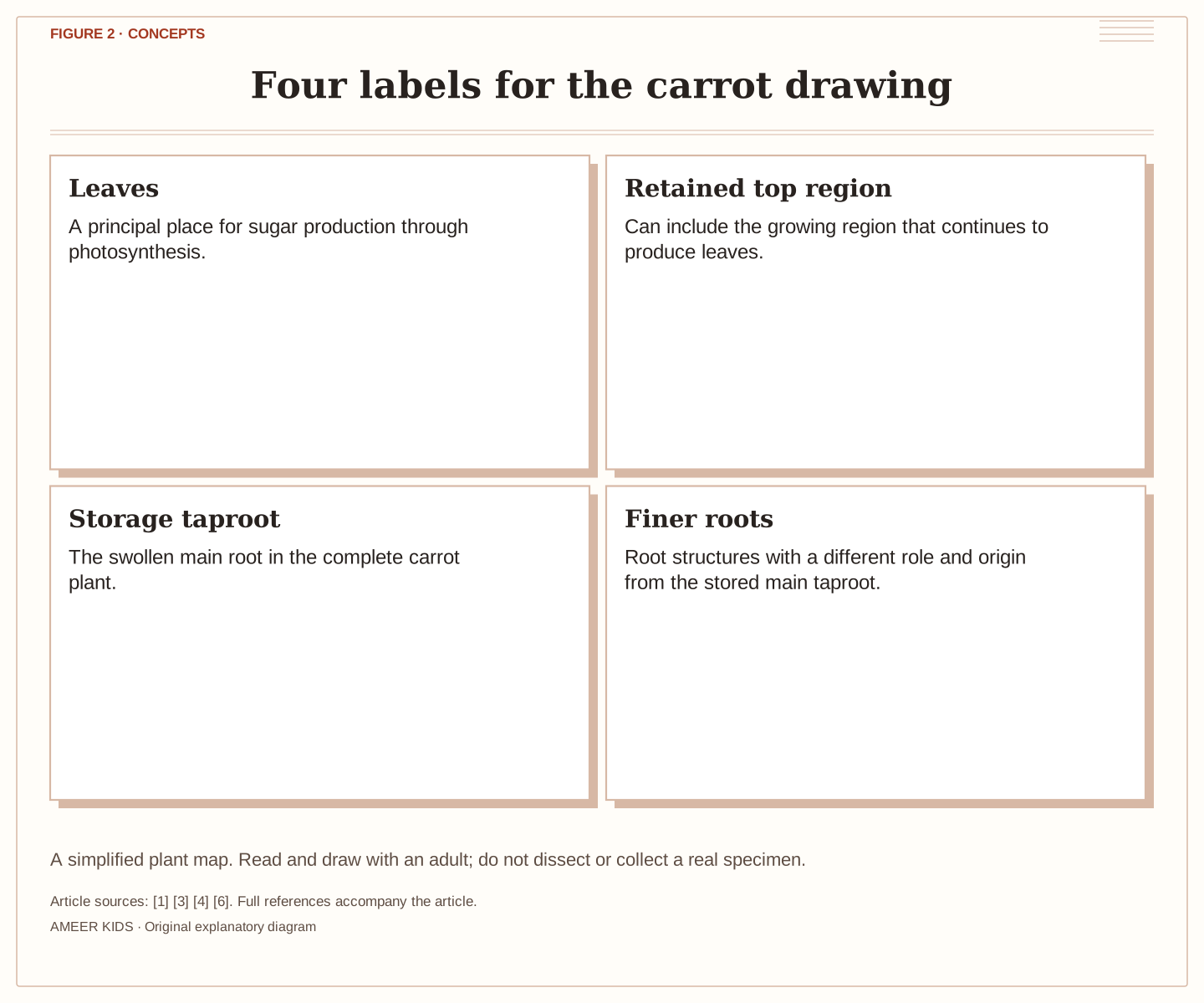
Four labels for the carrot drawing
A simplified plant map. Read and draw with an adult; do not dissect or collect a real specimen.
- Leaves
A principal place for sugar production through photosynthesis.
[1] [3] [4] [6] - Retained top region
Can include the growing region that continues to produce leaves.
[1] [3] [4] [6] - Storage taproot
The swollen main root in the complete carrot plant.
[1] [3] [4] [6] - Finer roots
Root structures with a different role and origin from the stored main taproot.
[1] [3] [4] [6]
Give the leaves, top and roots separate labels
Draw a familiar carrot plant as a simple map: leafy growth above, a small top region where the leaves arise, and a long thick root below. Add a few thinner roots branching from the root system. The thick carrot is a storage taproot. A taproot is a main root that develops from the young plant's original root. Oregon State's plant-parts guide names carrots as taproot examples, while the University of Saskatchewan describes smaller feeder roots extending from the main root [3][6].
Different labels help us ask different questions. Leaves are an important place where a plant makes sugars using light. Roots take up water and mineral nutrients, help anchor the plant, and can store materials [4][6]. The top region in our diagram includes the area that can continue producing leaves. These parts work together, but they do not all have the same structure or job. Your drawing does not need to look realistic. It needs clear labels so that 'new leaf' cannot quietly turn into 'new thick carrot' later in the explanation.
Use a schematic with the shoot region above the swollen root, the retained top region, the storage taproot and finer roots distinguished. Oregon State identifies a primary root as originating from the seedling embryo; when it persists as the central root it forms a taproot, with carrots among the examples [6]. Saskatchewan separately describes smaller feeder roots growing from the main carrot root [3]. A simplified diagram should preserve that structural distinction even though it omits detailed vascular anatomy and proportions.
Plant organs perform different but connected functions. Leaves are a principal site of photosynthesis; root systems absorb water and mineral nutrients, anchor the plant and can store compounds [4][6]. In the regrowth question, the retained top's shoot-growing region is especially important because its continued activity does not imply restoration of the original primary-root structure. The drawing is therefore a map of organs and developmental roles, not a botanical identification plate. Its labels should support the specific distinction the reader is being asked to make.
A growing point has a particular role
Plants do not grow only by stretching every old part equally. They have regions where new cells are produced. One name for such a growing region is meristem. You can say the word slowly with your adult helper: mer-i-stem. Oregon State describes a meristem near a root tip and explains that the carrot top can retain the growing region that produces leaves [1][6]. The name matters less than the idea: a growing part can continue one kind of development without replacing every missing part.
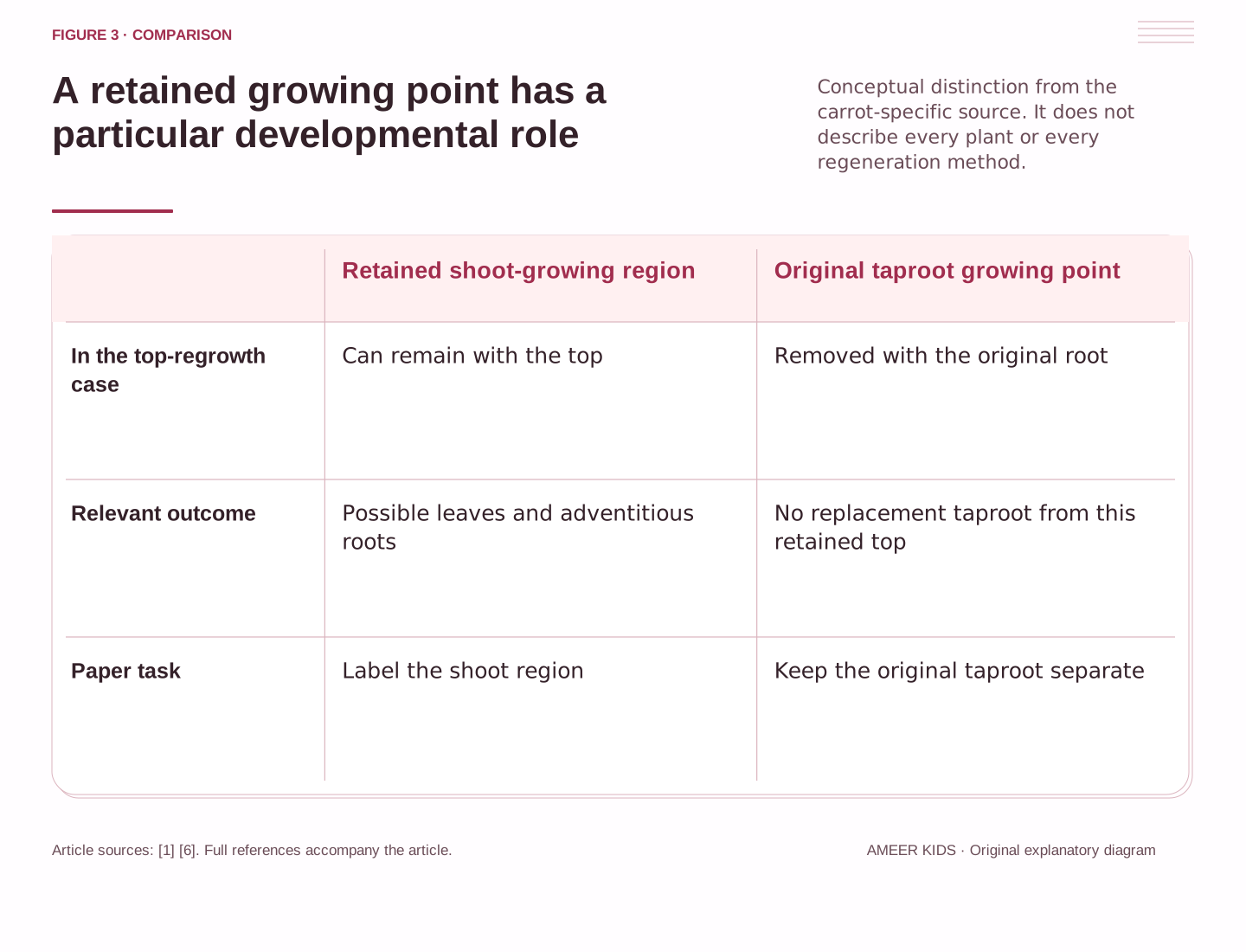
On your drawing, place a small star beside the leaf-growing region. Then point to the long taproot in the picture of the complete plant. In the carrot-top situation explained by the source, the original taproot's growing point is no longer present with the retained top [1]. Fresh leaves therefore do not prove that a new taproot is forming. We are comparing labeled pictures of different structures. Do not try to find the growing points by cutting a real carrot or taking a plant apart; the paper model supplies everything needed for this question.
Meristems are regions of active cell division associated with plant growth. Oregon State's vegetative-structure guide identifies the root-tip meristem, while its carrot-specific answer distinguishes the removed taproot growing point from the retained leaf-growing region [1][6]. The relevant mechanism is developmental organization, not the vague claim that a carrot is either completely alive or completely unable to grow. Some retained tissue can remain capable of producing organs even when the original storage taproot will not be reconstructed.
For the diagram, mark the retained shoot-growing region and separately identify the original taproot. Do not interpret the markers as a complete anatomical section or a universal account of all regeneration pathways. The cited carrot answer supports leaf regrowth in the usual retained-top case and explicitly rejects formation of another taproot from that top [1]. This bounded explanation is enough to evaluate the claim under discussion. A child is asked to connect labels and explanations, not to expose meristems, dissect tissue or manipulate a real specimen.
Read this figure in text
Conceptual distinction from the carrot-specific source. It does not describe every plant or every regeneration method.
| Item | Retained shoot-growing region | Original taproot growing point |
|---|---|---|
| In the top-regrowth case[1] [6] | Can remain with the top | Removed with the original root |
| Relevant outcome[1] [6] | Possible leaves and adventitious roots | No replacement taproot from this retained top |
| Paper task[1] [6] | Label the shoot region | Keep the original taproot separate |
Fine roots do not mean the thick taproot returned
A carrot top may also produce fine roots. Oregon State calls these adventitious roots: new roots arising from the retained top region in this situation [1]. They are real roots, so it would be wrong to say that a carrot top can never make any roots at all. The important correction is more precise. Fine new roots are not the same thing as a replacement for the original thick storage taproot.
Try two captions for an imaginary drawing that clearly labels several fine roots beneath a carrot top. 'Fine roots are shown' matches the picture. 'A new thick carrot has grown' adds something the picture does not show. The word root alone is too broad to settle the question. Think of identifying a part of a vehicle: saying 'a wheel is present' does not prove that the whole vehicle has been rebuilt. That comparison is only about careful wording; plants develop through living processes, not by having spare parts bolted into place.
There is one more useful word distinction: a fine root is not the same thing as a root hair. Root hairs are tiny extensions of cells on parts of a root’s outer surface. They increase the surface available for taking in water and minerals [6]. A fine root is a whole root structure, which can itself have such surface features. Our diagrams label fine roots and do not ask you to see root hairs. This matters when reading a drawing: a thin pencil line may stand for a whole root, while a close-up would need different labels and a different scale.
Adventitious roots arise outside the ordinary origin of the primary root. The carrot-specific Oregon State account states that the retained growing region can produce adventitious fibrous roots but not another taproot [1]. Thus 'no roots can regrow' would overcorrect the misconception. The accurate distinction is between root production of that type and reconstitution of the original storage taproot. The general root guide supplies the contrasting developmental origin of the primary root in the embryo [6].
A fictional diagram showing fine roots supports a claim about those labeled roots, not an additional claim about a new swollen storage organ. The inference depends on organ identity rather than simply the presence of white strands or visible growth. This also explains why a general statement about successful rooting in another plant species cannot automatically establish the same outcome for carrot tops. Rooting, shoot growth and storage-organ development are separable observations. The article does not identify unknown strands in a real photograph or turn appearance into a test of food safety.
Root hairs and fine roots should also remain distinct. Oregon State describes root hairs as elongated epidermal cells that increase absorptive surface area [6]. A fine root is a multicellular organ, whereas a root hair is a specialized extension at its surface; the terms identify different structural scales. The carrot-top source uses adventitious fibrous roots, not a claim that a few root-hair cells will enlarge into the missing storage taproot. Our coarse drawings label complete roots and do not represent microscopic epidermal features. This scale distinction prevents the visual shorthand of thin lines from changing the biological claim.
The thick root is part of the plant’s energy story
A carrot plant's green leaves can use light energy, carbon dioxide and water to make sugars through photosynthesis. The plant can use those sugars, move them to other parts or store them [5][6]. Roots bring in water and mineral nutrients, but the soil is not simply a delivery box of ready-made sugar for the plant. Keeping these jobs separate helps explain why leaves and a storage root can depend on each other without being interchangeable.
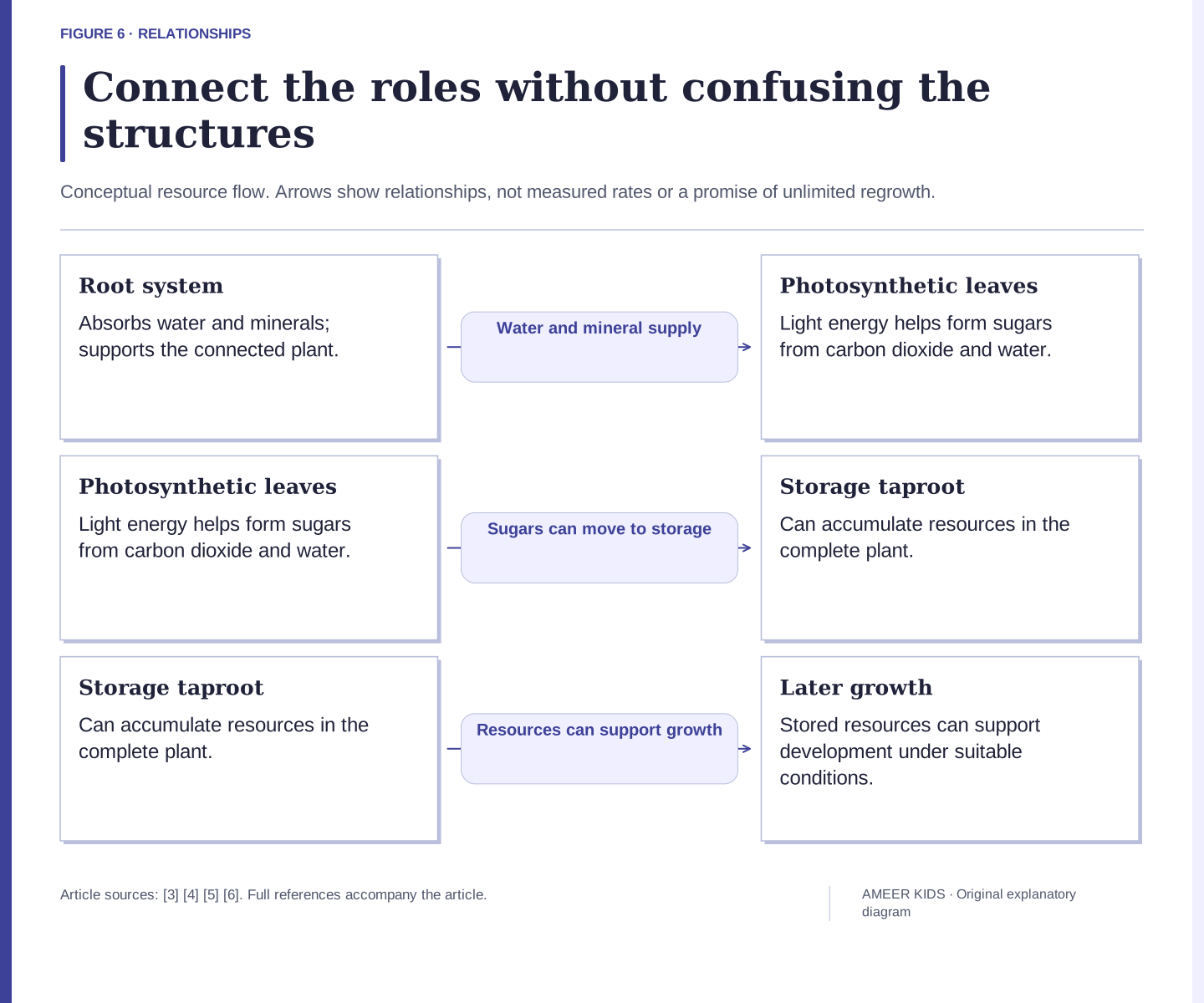
The University of Saskatchewan describes carrots storing natural sugars in the taproot during their first growing season, then using stored resources for later flowering and seed production when the plant survives under suitable conditions [3]. Draw an arrow from the leaves toward the storage root and label it 'sugars can be moved and stored.' A stored resource helps support later growth; it is not an unlimited supply. Seeing leaves appear on a retained top does not show that a large store has been replaced. Our drawing explains roles, not measured quantities of sugar or energy.
Photosynthesis uses light energy with carbon dioxide and water to form carbohydrates, which plants can use, transport or store. Leaves are a principal photosynthetic location, and root systems supply water and mineral nutrients [4][5][6]. This distinguishes carbohydrate production from mineral acquisition. The distinction does not imply that roots are inactive; they are living organs with transport, storage and metabolic functions. No universal claim about every root in every plant being incapable of photosynthesis is necessary for this carrot explanation.
Saskatchewan describes first-season sugar storage in the carrot taproot and later use of stored resources during flowering and seed formation where the plant successfully overwinters [3]. These are developmental roles, not a complete carbon budget. The conceptual arrow from photosynthetic tissue toward storage indicates possible movement and allocation of compounds; it does not specify a rate or imply that all produced sugar reaches the root. Continued shoot growth and reconstruction of the removed storage organ remain different outcomes. Neither can be quantified from a leaf-only picture.
A two-season pattern is not an exact timer
Many garden carrots are described as biennial. In the usual pattern, the first growing season builds leaves and the storage root. If the plant survives and conditions are suitable, later growth can include a flowering stalk and seeds. The University of Florida and University of Saskatchewan describe this broad life-cycle pattern [2][3]. A carrot sold as a root vegetable is only one stage in a plant's longer story. The plant also has a reproductive stage, even if you never see it in a shop picture.
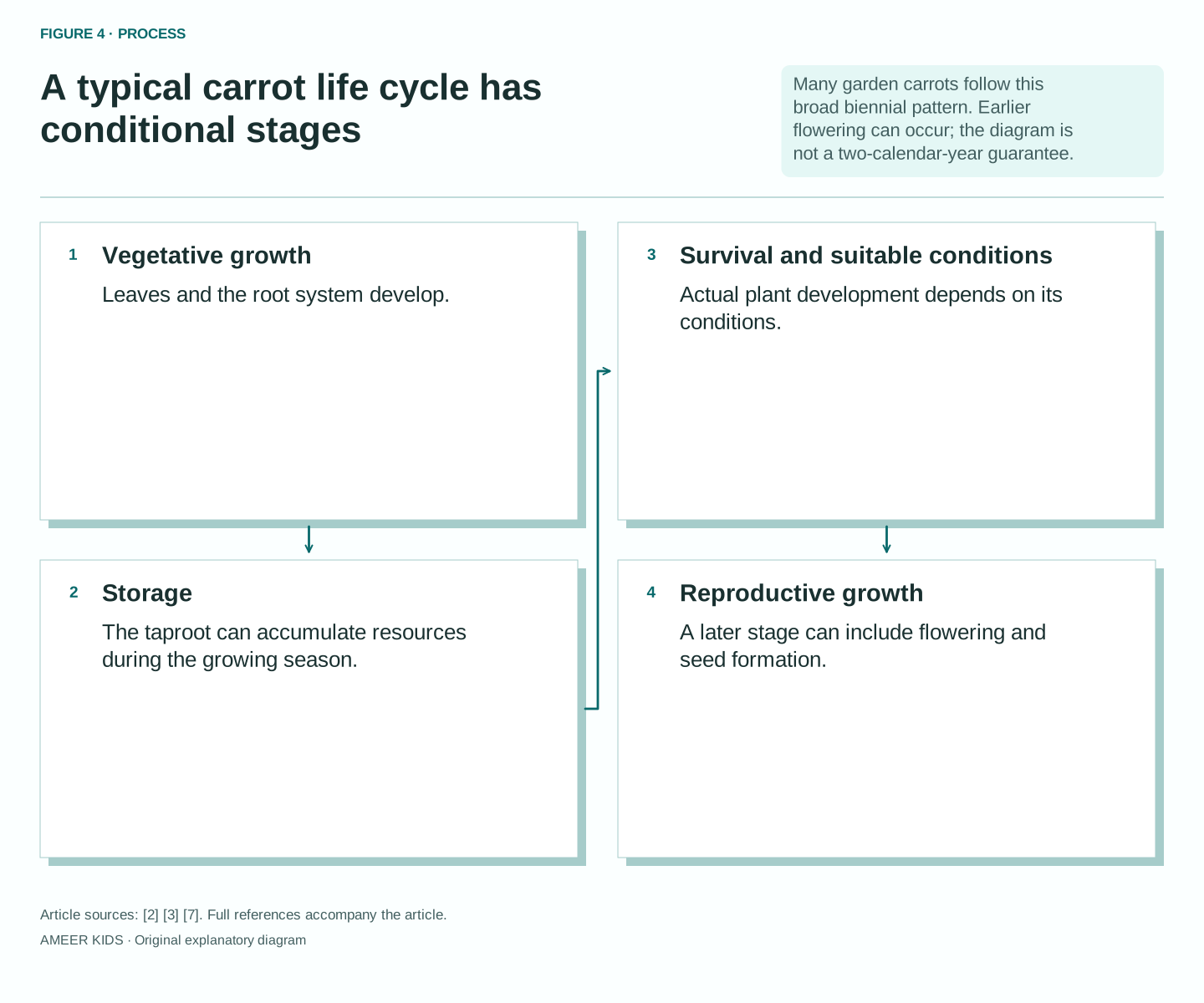
Do not turn 'biennial' into a promise that every carrot waits exactly two calendar years. The Royal Horticultural Society explains that carrots and other biennial crops can begin flowering earlier after particular cold conditions [7]. Variety and conditions matter. On paper, use arrows labeled 'growth and storage' and 'later flowering under suitable conditions,' rather than dates that claim to fit every plant. Nor does the life-cycle diagram promise that any particular retained top will flower, make viable seeds or survive. A general pattern leaves room for actual conditions.
The ordinary garden-carrot account describes biennial development: vegetative growth and storage precede a later reproductive phase when environmental and developmental requirements are met. Florida identifies the second-season flowering pattern, while Saskatchewan makes successful overwintering an explicit condition in its regional account [2][3]. This framework explains the functional importance of the storage organ without equating the harvested vegetable with the plant's complete life cycle.
The schedule requires qualification. RHS describes earlier floral initiation in biennial crops including carrots following suitable cold exposure, rather than an invariant two-calendar-year deadline [7]. Consequently, the diagram represents stages and conditional transitions, not a universal elapsed-time prediction. The article does not specify chilling durations, temperatures, a seed-production recipe or a guarantee for a detached top. Distinguishing the typical pattern from possible variation prevents two opposite errors: assuming carrots never flower because they are root vegetables, and assuming every carrot must follow an identical calendar.
Read this figure in text
A typical carrot life cycle has conditional stages
Many garden carrots follow this broad biennial pattern. Earlier flowering can occur; the diagram is not a two-calendar-year guarantee.
- Vegetative growth
Leaves and the root system develop.
[2] [3] [7] - Storage
The taproot can accumulate resources during the growing season.
[2] [3] [7] - Survival and suitable conditions
Actual plant development depends on its conditions.
[2] [3] [7] - Reproductive growth
A later stage can include flowering and seed formation.
[2] [3] [7]
Starting from a seed is a different route
A new carrot plant can develop from a seed. That route includes the seedling's original root, which can develop into its taproot [6]. It is different from asking a retained top to rebuild the root that was removed. The two stories may both involve green leaves, but they begin with different plant structures. Use two separate rows in your drawing so that the arrows do not accidentally turn one story into the other.
In the seed row, write 'seed,' 'young plant,' and 'developing root system.' In the top row, write 'retained top,' then 'possible leaves and fine roots.' These are conceptual labels, not instructions to collect or plant seeds. The Oregon State answer explains why a seed-produced new carrot and leaf regrowth from a top should not be confused [1]. The same word, regrow, can hide that difference. Ask which starting structure a claim refers to before deciding what the later growth means.
Seedling development and retained-top regrowth begin from different anatomical starting points. The primary root develops from the embryo, and a persistent primary root can become the taproot [6]. A retained carrot top lacks the original taproot growing point in the situation described by the carrot-specific source [1]. The presence of new foliage in both scenarios does not erase that developmental distinction. One cannot infer a seedling's root-development pathway from a superficially similar shoot response in retained tissue.
Represent the routes in separate rows: seed to seedling and developing root system; retained top to possible shoot growth and adventitious roots. The arrows show conceptual relationships, not a timetable or guaranteed survival sequence. The source's discussion of seed production explains the biological distinction, but this article does not convert it into an instruction to flower, pollinate, harvest or sow. A young reader can explain the contrasting origins from the diagram alone. No physical seed handling or plant-growing setup adds necessary evidence to this paper exercise.
Three more leaves still means a leaf count
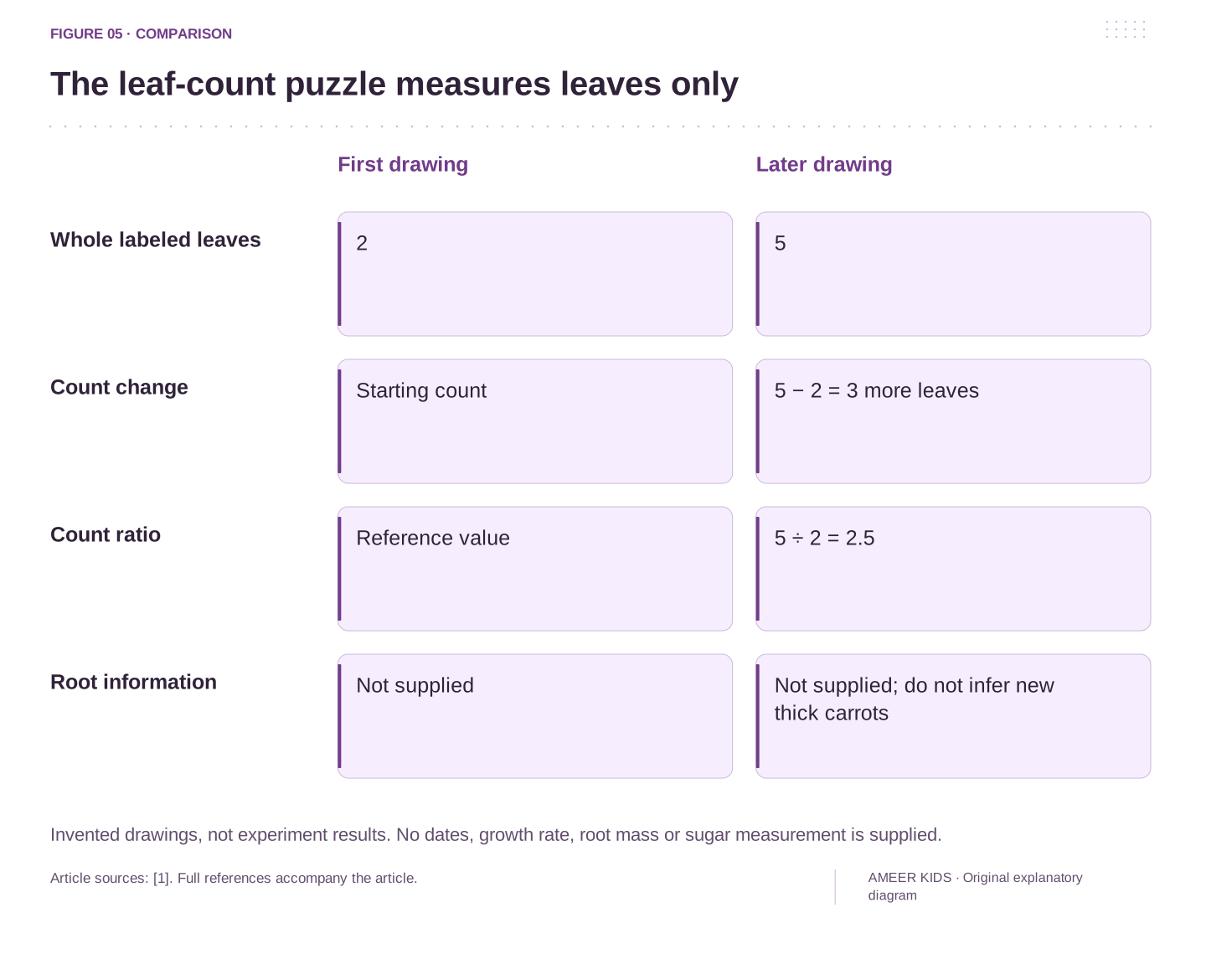
Here is a made-up observation puzzle. A first drawing shows two clearly labeled whole leaves. A later drawing of the same imaginary top shows five. How many more leaves are shown? Five minus two is three. Ask your adult helper to check that you counted whole leaves, not separate little pieces drawn along a leaf. The drawings are invented and have no dates, measurements or promises about how quickly a real plant grows.
Now compare two statements. 'The illustrated leaf count increased by three' follows from the puzzle. 'Three new thick carrots appeared' does not. The drawings supply no such root evidence. Even saying the plant has two and a half times as much total material would go beyond the count. Five is two and a half times two, but counting leaves does not measure their mass, the root's mass or stored sugar. Always keep the thing counted beside the number; a correct calculation can still answer the wrong question.
Use an artificial two-frame record with whole-leaf counts of n1 = 2 and n2 = 5. The count change is Δn = 5 − 2 = 3, and the ratio n2/n1 = 2.5. The observation definition matters because carrot foliage contains divided leaf structures; the puzzle specifies whole labeled leaves rather than every drawn segment. No real plant was observed and no elapsed interval is supplied, so the example supports neither an empirical growth rate nor a horticultural forecast.
The number's unit remains whole leaves. A 2.5 count ratio is not a 2.5 biomass ratio, a storage-root count or a carbohydrate measurement. The frames cannot establish a replacement taproot merely by showing increased foliage. This is an original exercise in matching measurement to conclusion: identify the object counted, perform the arithmetic, then restrict the statement to what the record provides. It also avoids turning absence of a root measurement into a measured zero; root information in the puzzle is simply not supplied.
Read this figure in text
Invented drawings, not experiment results. No dates, growth rate, root mass or sugar measurement is supplied.
| Item | First drawing | Later drawing |
|---|---|---|
| Whole labeled leaves[1] | 2 | 5 |
| Count change[1] | Starting count | 5 − 2 = 3 more leaves |
| Count ratio[1] | Reference value | 5 ÷ 2 = 2.5 |
| Root information[1] | Not supplied | Not supplied; do not infer new thick carrots |
Figure references [1]
Ask what a picture actually establishes
An image can show only part of a plant. If the frame includes green leaves but hides the lower part, it cannot by itself tell you what roots are present. If a drawing includes a large root, ask whether the story says it was already there or developed later. Before-and-after labels need a clear starting point. A single cheerful caption is not enough to establish that the original thick root was rebuilt.
On a paper page, make three boxes called 'Shown,' 'Explained by a source' and 'Still unknown.' Put the imaginary leaf count in the first box. Put Oregon State's distinction between fine-root growth and replacement of the taproot in the second [1]. Leave the actual outcome for an unidentified real photograph in the third. These boxes keep different kinds of information visible. They are not a game of guessing whether an unknown plant is edible. Stay with the drawings; do not collect, touch or taste plants to fill a missing box.
Image evidence has a field-of-view and provenance boundary. A crop showing foliage cannot establish a hidden root system. An image showing a large root also needs a clear temporal account before it supports the claim that the root developed after removal of an earlier one. The distinction between an original retained organ and newly formed tissue matters. These are reasoning requirements for an evidence claim, not an instruction to set up a time-lapse experiment.
The paper worksheet separates depicted observations, source-supported mechanisms and unresolved specimen-specific facts. The carrot source supports the typical retained-top mechanism [1]; it does not identify every plant presented in a social-media image or certify what happened outside its frame. Similarly, the imaginary count puzzle remains an invented record even when its arithmetic is correct. No food-safety, species-identification or medical conclusion follows. An adult can help a child practice these boundaries using the supplied diagrams without handling plants, searching for specimens or uploading personal photographs.
Finish with a precise regrowth sentence
Choose the best ending to this sentence: 'In the carrot-top situation described here, fresh green leaves show…' A good answer is 'that leaf growth can continue.' They do not show that the original thick taproot has been replaced. Fine roots may also appear, and naming them correctly makes the explanation more accurate [1]. Point to the growing region, the leaves and the two kinds of root in your drawings as you explain the difference to your adult helper.
Then retell the energy and life-cycle story. Leaves help make sugars, a carrot's storage root can hold resources, and a surviving plant may later flower under suitable conditions [2][3][5]. Those facts explain connected roles, not an endless vegetable machine. Keep the six-figure story and the invented leaf-count exercise separate from actual measurements. You have completed the activity when you can say what grew, what evidence supports that statement and what remains unknown. No cutting, seeds, tasting, gardening tools or online account is needed.
The final explanation should name the observed or supported organ. In the usual carrot-top case, retained shoot-growing tissue can produce foliage and adventitious roots, while the original storage taproot is not regenerated [1]. This is more accurate than either 'the whole carrot grew back' or 'nothing can grow.' The conclusion depends on developmental structure and the specific mechanism described, rather than on a broad rule about every plant's regenerative capacity.
Connect that conclusion to the plant's source-and-storage roles and conditional reproductive development [2][3][5][6][7]. Then verify the original puzzle separately: the fictional whole-leaf count rises from two to five, while root mass and storage remain unmeasured. A precise explanation preserves these different evidence types. The lesson is complete as a private, adult-supported paper activity, with no physical propagation, tools, seed handling, tasting, wild-plant contact or collection of personal data. Its successful outcome is a defensible interpretation of growth, not a claim to have grown or tested a carrot.
Read this figure in text
Connect the roles without confusing the structures
Conceptual resource flow. Arrows show relationships, not measured rates or a promise of unlimited regrowth.
Elements
- Photosynthetic leaves
Light energy helps form sugars from carbon dioxide and water.
[3] [4] [5] [6] - Root system
Absorbs water and minerals; supports the connected plant.
[3] [4] [5] [6] - Storage taproot
Can accumulate resources in the complete plant.
[3] [4] [5] [6] - Later growth
Stored resources can support development under suitable conditions.
[3] [4] [5] [6]
Connections
Sources & further reading
Explore the references behind this guide. External pages may change after our review.
- Can I regrow carrots by planting the tops? | OSU Extension ServiceOregon State University Extension Service · Accessed 6 Nov 2026
- Carrots – Gardening SolutionsUniversity of Florida / IFAS Extension · Accessed 6 Nov 2026
- Carrots - Gardening at USask - College of Agriculture and Bioresources | University of SaskatchewanUniversity of Saskatchewan / College of Agriculture and Bioresources · Accessed 6 Nov 2026
- Putting Down Roots | Extension | West Virginia UniversityWest Virginia University Extension · Accessed 6 Nov 2026
- Plant growth and development | OSU Extension ServiceOregon State University Extension · Accessed 6 Nov 2026
- Vegetative plant parts | OSU Extension ServiceOregon State University Extension · Accessed 6 Nov 2026
- Bolting in Vegetables | RHS AdviceRoyal Horticultural Society · Accessed 6 Nov 2026
Article updated 8 Nov 2026.